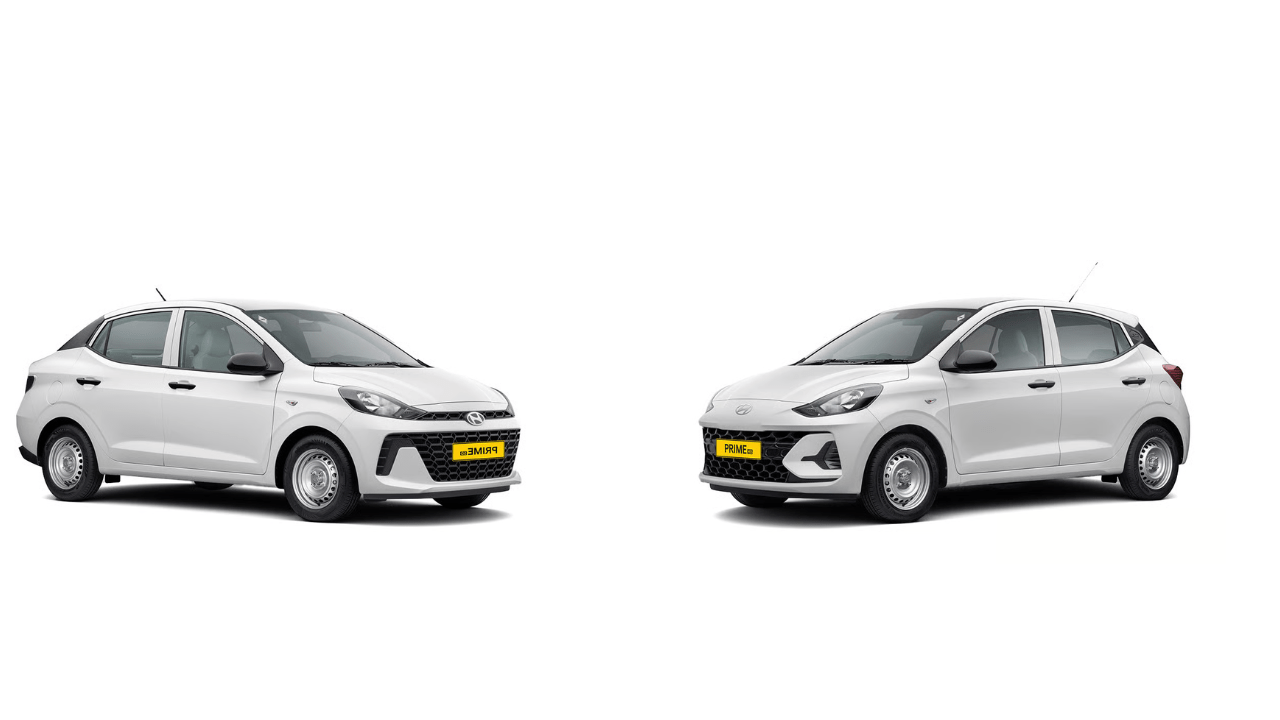
Hyundai Prime HB & Prime SD Launched: CNG Fleet Cars That Slash Running Costs and Raise Safety Standards
While most of the automotive market is busy obsessing over panoramic sunroofs and 360-degree cameras, Hyundai has quietly launched something far more strategic.
No flashy reveal.
No influencer campaigns.
No lifestyle ads.
Instead, Hyundai has introduced two purpose-built commercial vehicles:
Hyundai Prime HB
Hyundai Prime SD
And these aren’t just trimmed-down versions of existing cars.
They are factory-engineered fleet machines designed for one goal:
- Maximum profit per kilometre.
What Are Hyundai Prime HB and Prime SD?
The Prime HB and Prime SD are commercial-only variants based on:
- Prime HB → Based on Hyundai Grand i10 Nios
- Prime SD → Based on Hyundai Aura
However, Hyundai has not simply rebadged these cars.
These models are built specifically for:
- Taxi operators
- Ride-hailing drivers
- Corporate mobility fleets
- Airport taxi services
- City fleet businesses
Most importantly:
- They are not available for private registration.
Hyundai is targeting the commercial mobility ecosystem directly.
Built Only for Fleet, Built Only to Work
Hyundai understands one critical truth about the Indian fleet market:
Downtime kills profits.
That’s why both Prime models are:
- Factory-fitted with CNG
- Engineered for durability
- Optimized for low running cost
- Designed for high daily mileage
This is not an aftermarket CNG setup.
It is fully integrated and factory-calibrated.
That means:
- Better reliability
- Safer gas system integration
- No warranty issues
- Proper ECU tuning
For fleet operators, that matters.
Engine and Performance: Simple, Proven, Durable
Under the hood of both Prime HB and Prime SD sits Hyundai’s trusted:
1.2-litre Kappa Four-Cylinder Engine (CNG Mode)
- Power: 69 PS
- Torque: 95.2 Nm
- Transmission: 5-speed manual
- Fuel: Factory-fitted CNG
This engine is already proven in lakhs of vehicles across India.
Hyundai didn’t experiment with turbocharging.
Didn’t add unnecessary complexity.
Fleet cars don’t need excitement.
They need dependability.
Mileage That Directly Attacks Diesel & EV Economics
Hyundai has clearly optimized these vehicles for operating cost efficiency.
Claimed Mileage (ARAI)
- Prime HB: 27.32 km/kg
- Prime SD: 28.40 km/kg
For fleet operators, this translates to something far more important:
Estimated Running Cost: ~47 paise per kilometre
That number is crucial.
It directly challenges:
- Diesel hatchbacks
- Compact diesel sedans
- Entry-level EV fleet vehicles
In dense urban operations, CNG often delivers more predictable operating cost compared to fluctuating diesel prices.
Hyundai is targeting that gap.
Six Airbags in a Fleet Car? That’s a Game-Changer
This is where Hyundai has shocked the segment.
Both Prime HB and Prime SD come with:
Six Airbags — Standard
Not optional.
Not variant-based.
Not limited to top trims.
In India’s commercial segment, this is rare.
Most fleet cars prioritize cost over safety.
Hyundai flipped that equation.
Additional Safety Features
Beyond six airbags, both Prime models include:
- Rear parking sensors
- 80 km/h speed limiter
- ABS with EBD
- Structural reinforcement
The 80 km/h limiter is especially relevant for:
- Highway fleet safety
- Regulatory compliance
- Reduced accident risk
This move may pressure competitors to upgrade their fleet offerings.
Comfort Features: Practical, Not Excessive
Hyundai hasn’t stripped these cars bare.
Instead, it has provided what fleet drivers and passengers genuinely need.
Standard Equipment Includes:
- Power windows
- Central locking
- Rear AC vents
- Steering-mounted audio controls
- Adjustable front headrests
The Prime HB goes slightly further with:
- Rear adjustable headrests
- Keyless entry
This improves passenger comfort without increasing unnecessary cost.
Hyundai has struck a balance between:
Cost control
Usability
Professional presentation
Optional Features That Make Business Sense
Instead of forcing expensive packages, Hyundai offers optional add-ons.
Fleet operators can choose based on their business model.
Available Optional Features:
- 9-inch touchscreen infotainment system
- Wireless smartphone connectivity
- Rear parking camera
- Vehicle tracking device
- Panic button system
For app-based taxi operators, vehicle tracking and panic buttons are especially valuable.
This modular approach prevents over-investment.
Fleet economics are about ROI per rupee.
Hyundai understands that.
Boot Space Despite CNG: Surprisingly Practical
CNG cars often compromise luggage capacity.
Hyundai has tried to minimize that drawback.
Boot Space
- Prime HB: Approx. 260 litres
- Prime SD: Approx. 405 litres
For airport runs and city rides, this remains usable.
The sedan (Prime SD) clearly benefits more in cargo flexibility.
For fleet operators handling luggage-heavy routes, the sedan may be more attractive.
Warranty & Long-Term Ownership Advantage
Hyundai is offering:
- 3-year standard warranty
- Extendable up to 5 years / 1,80,000 km
For high-usage fleet vehicles, this is crucial.
Extended warranty reduces:
- Unexpected repair expenses
- Risk exposure
- Downtime losses
Hyundai’s wide service network also supports fleet scaling across cities.
Exterior Colors & Commercial Identity
Available color options include:
- Atlas White
- Typhoon Silver
- Abyss Black
These are neutral, professional colors suitable for fleet branding.
Hyundai dealerships now feature:
Dedicated commercial advisors
Fleet booking support
Business consultation assistance
This indicates Hyundai’s serious intent in the commercial segment.
Why Hyundai Entered Fleet Segment Aggressively Now
India’s mobility market is evolving rapidly.
Ride-hailing services are expanding.
Corporate transport demand is rising.
CNG infrastructure is improving.
Hyundai likely saw three major trends:
- Rising CNG adoption in metro cities
- Increasing safety expectations
- Fleet demand shifting from diesel
Instead of letting competitors dominate, Hyundai has strategically entered with factory-optimized models.
Hyundai Prime HB vs Hyundai Prime SD: Which Makes More Sense?
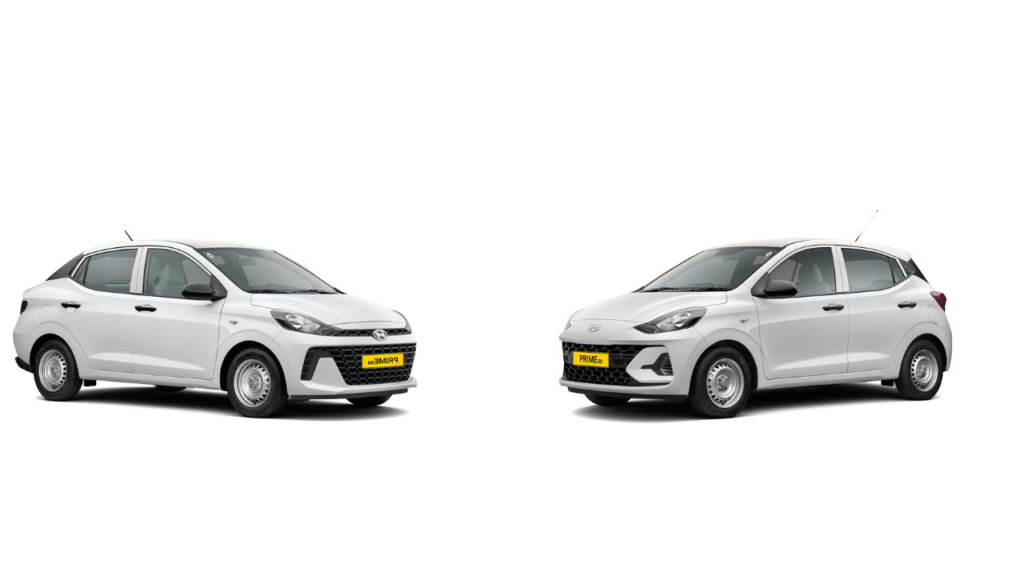
Choose Prime HB If:
- You want lower acquisition cost
- You operate mostly short urban routes
- Passenger luggage demand is limited
- You prioritize compact city maneuverability
Choose Prime SD If:
- You operate airport or intercity runs
- You need larger boot space
- You want slightly better mileage
- You serve premium fleet customers
Both are cost-focused.
But the sedan may deliver better long-route profitability.
How This Launch Impacts Rivals
Competitors in fleet space include:
- Maruti commercial offerings
- Tata fleet variants
- Entry-level diesel sedans
Hyundai’s advantages:
- Six airbags standard
- Factory CNG integration
- Strong brand perception
- Modern design base
This launch could pressure rivals to upgrade safety in commercial cars.
Why Private Buyers Can’t Purchase These
Hyundai has restricted these models to commercial registration.
Why?
Because:
- Pricing structure is fleet-optimized
- Equipment balance is business-focused
- Brand positioning must remain premium for private buyers
By separating fleet and retail offerings, Hyundai protects its consumer image while expanding commercial reach.
Smart move.
My Thoughts:
Hyundai Prime HB and Hyundai Prime SD both are very good commercial cars. Although it can be used by family oriented needs for travelling. Both the vehicles are CNG based which benefits the owner for high mileage with the less expenses. Also the vehicles have a good decent comfort in it wih multiple airbags as safety for the passenger and driver. So Hyundai Prime HB and Hyundai Prime SD both are best choices for commercial purpose.
Final Verdict: A Silent but Strategic Masterstroke
The Hyundai Prime HB and Prime SD may not trend on social media.
But in the commercial world, they matter.
They offer:
- Ultra-low running cost
- Factory CNG reliability
- Six airbags standard
- Practical comfort
- Fleet-focused warranty
- Scalable business usability
Hyundai isn’t chasing glamour here.
It’s chasing fleet dominance.
And by combining safety with profitability, the Prime models could quietly reshape India’s commercial car market.
Private buyers may never see them.
Fleet operators absolutely will.
And many competitors won’t like what they see.
You can enquire about Hyundai Prime HB and Hyundai Prime SD to know more details.
Also Read: